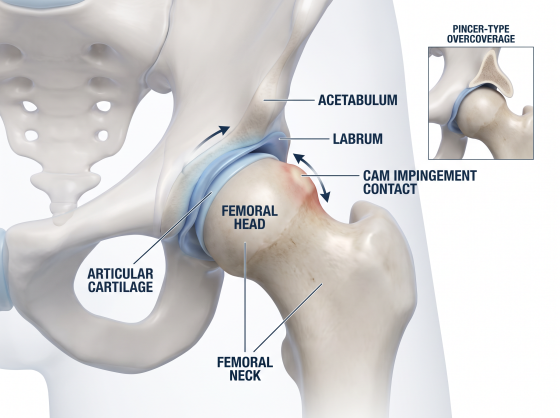
Symptomatic nonarthritic hip condition involving motion-related hip/groin pain with clinical findings and cam/pincer morphology when imaging is relevant.
THE MSK CLINICAL STORY
A hip pinch, a deep squat and a misleading positive test
A fictional teaching case. Follow the clues, enjoy the conversation, and make the decisions a thoughtful clinician would make—not an instant diagnosis from a single symptom.
Scene 01 · The patient walks in
A young weightlifter says deep squats create a pinch in the groin. A video says one FADIR test can 'diagnose a cam.' The clinician quietly puts away the crystal ball.
A little clinic conversation
Lifter: 'FADIR hurt. So I definitely need surgery?' Therapist: 'One painful test doesn't get to write the whole ending.'
Scene 02 · Follow the clues
FAI syndrome involves symptoms, compatible examination and relevant imaging findings. Hip morphology alone can be present in people without symptoms.
Plot twist · What could fool us?
A positive FADIR reproduces pain but is not specific for FAIS. Consider hip OA, labral-related problems, lumbar referral and other causes as appropriate.
Choose your learning lens
Same clinical case, two ways to understand it. The complete examination and treatment guide is still available below.
In everyday words
Some hip positions may bring tissues into an uncomfortable range. We'll look at your symptoms, movement and imaging if needed, then build a plan for the activities you value.
Scene 03 · The rehabilitation journey
Adjust painful depth and training load → rebuild hip/trunk strength and movement options → graded return to squatting or sport.
A lifter has groin pain and a positive FADIR test. What is required before diagnosing FAIS?
Choose one answer to reveal the explanation. No score, no pressure—just better clinical reasoning.
These cases teach reasoning; they do not provide a diagnosis for an individual patient. Always consider red flags, contraindications, comorbidities and local referral pathways.
Use symptom-relieving options only if they help participation in active rehabilitation.
Return / Discharge Criteria
Functional hip ROM
Strong hip/trunk control
Pain-controlled deep flexion/pivoting as required
Sport-specific change of direction tolerated
Common Clinical Mistakes
Treating imaging morphology rather than symptoms/function
Aggressive stretching into painful impingement
Ignoring trunk/lower-limb movement strategy
Clinical Pearls
FADIR reproduces symptoms but does not by itself diagnose FAIS.
A multimodal program of activity modification, strengthening, movement training and selective manual therapy is supported.
Continue learning
Connect assessment with management
Use the related PNA learning pathways to explore examination techniques and structured rehabilitation. A test result should always be interpreted alongside the history, full examination and clinical presentation.
Use these sources as a starting point for clinical learning. A reference being listed here does not, by itself, establish that every recommendation on this page is strongly supported. Check the original publication, study design, population and limitations before applying findings to an individual patient.
Educational resource only. Tests and treatment plans must be adapted to the individual patient, irritability, comorbidities, surgical restrictions and local scope-of-practice requirements.