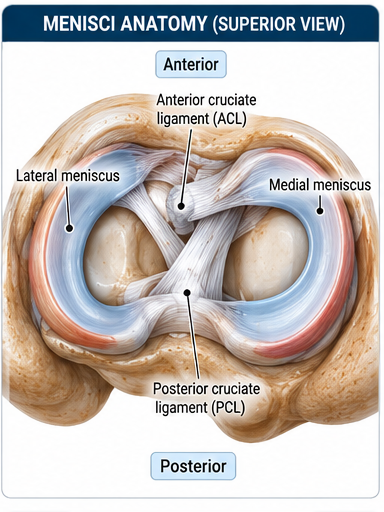
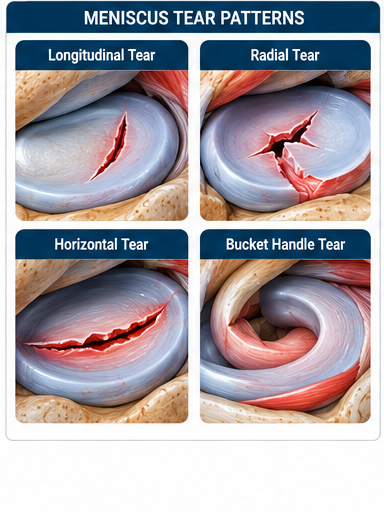
Traumatic or degenerative injury of the medial or lateral meniscus, presenting with joint-line pain, swelling and sometimes catching or locking.
THE MSK CLINICAL STORY
The clicking knee: innocent sound or mechanical plot twist?
A fictional teaching case. Follow the clues, enjoy the conversation, and make the decisions a thoughtful clinician would make—not an instant diagnosis from a single symptom.
Scene 01 · The patient walks in
A gardener twists while rising from a deep squat. His knee aches along the joint line. Every click is now described as 'the cartilage escaping.' Then he adds one detail: on one occasion the knee physically would not straighten.
A little clinic conversation
Patient: 'The click means my meniscus is gone, doesn't it?' Therapist: 'No. Knees are allowed to make sound effects. A truly locked knee is a different story.'
Scene 02 · Follow the clues
Joint-line pain after twisting may fit meniscal pathology, but clicks alone have poor diagnostic value. Distinguish a true fixed extension block from motion limited by pain or fear.
Plot twist · What could fool us?
A displaced tear can cause true locking and needs timely specialist assessment. Many non-locked presentations improve with an individualized rehabilitation approach.
Choose your learning lens
Same clinical case, two ways to understand it. The complete examination and treatment guide is still available below.
In everyday words
The shock-absorbing cartilage inside your knee may be irritated or injured. Clicking alone is common, but if the knee is genuinely stuck, that changes what we do next.
Scene 03 · The rehabilitation journey
When there is no urgent mechanical block: calm symptoms, restore extension and gait, strengthen the knee and hip, then reintroduce squats, turns and desired activities.
After a twist, a patient cannot fully extend the knee because it seems physically blocked. Your next move?
Choose one answer to reveal the explanation. No score, no pressure—just better clinical reasoning.
These cases teach reasoning; they do not provide a diagnosis for an individual patient. Always consider red flags, contraindications, comorbidities and local referral pathways.
True mechanical locking is different from pain-limited motion.
Continue learning
Connect assessment with management
Use the related PNA learning pathways to explore examination techniques and structured rehabilitation. A test result should always be interpreted alongside the history, full examination and clinical presentation.
Use these sources as a starting point for clinical learning. A reference being listed here does not, by itself, establish that every recommendation on this page is strongly supported. Check the original publication, study design, population and limitations before applying findings to an individual patient.
Educational resource only. Tests and treatment plans must be adapted to the individual patient, irritability, comorbidities, surgical restrictions and local scope-of-practice requirements.